
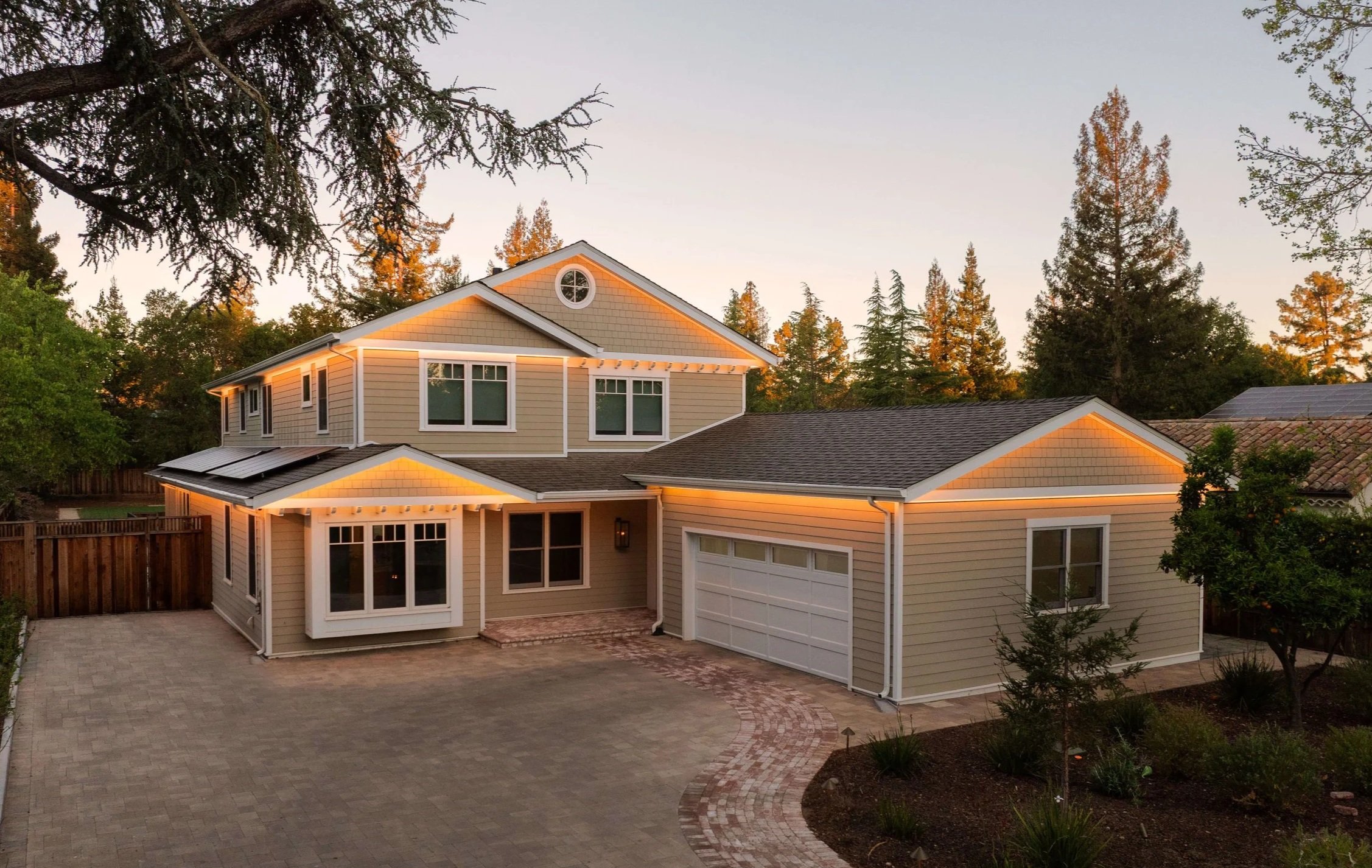
Client story · Los Altos, CA
The Eave Line
A Los Altos estate, engineered for energy autonomy from the ground up.
At a glance
Four systems, engineered as one
Energy Integration
Roofline, conduit routing, and envelope insulation planned around energy performance before framing began.
Energy Production
~15-panel Enphase solar array paired with a 22kW natural gas backup generator, installed by Freedom Solar.
Energy Storage
Enphase 5kWh battery, expandable to 8 units (40kWh) on the same micro-inverter architecture.
Energy Control
Lutron lighting across primary living areas and exterior, plus relay-based load management for backup priority.
The Impact
Installed today, room for tomorrow
System capacity: installed vs. expansion headroom
The Eave Line, Los Altos, CA
Source: KDM Energy project engineering, 2026.
The Brief
It started with a sentence
Not every energy system starts with a spec sheet. This one started with a sentence.
The build began the way most new construction in California does now — a baseline solar requirement written into the permit. But early into the project, the homeowner made the real goal clear: full independence from PG&E. Not a reduced bill. Off the grid, on their terms.
Alongside that came a second requirement that had nothing to do with solar math: a whole-home backup generator, non-negotiable, decided before a single panel was ever discussed. For a family of six, “the power goes out” isn’t an inconvenience — it’s a complete residential shut down with no heat, no refrigeration, and no hot water. The generator wasn’t a nice-to-have layered on top of the solar system. It was the anchor the rest of the system got engineered around.
“If I don’t have to pay PG&E, that’d be amazing.”
That was the entire brief for this project.
The Constraint
The minimum footprint for real autonomy
The first version of this system was built to answer one question: what does it take to cover this house’s energy needs completely, with nothing held back? The answer was north of 40 panels and a full Enphase battery bank — a combined solar and storage investment of approximately $250,000.
That number ran headlong into a build that was already over budget. So the system got re-engineered around a harder question: what’s the minimum footprint that still delivers real autonomy?
The answer that shipped: roughly 15 panels and a single Enphase battery, paired with the 22kW generator through Enphase’s controller — configured so backup power kicks in with zero interruption. No flicker, no reset, no gap between grid loss and generator power. Integrated with battery storage, the handoff is instant.
The Engineering
Built to disappear, built to grow
A house designed around the system, not the other way around
Because this was new construction, the energy system could be planned before a single wall went up. The south-facing roof plane — the one that matters for panel output — was kept completely clear. Roof vents, exhaust fans, even the fireplace flue were routed to the north-facing side instead, and every conduit run for the solar array was brought inside the building envelope, surfacing only through roof jacks hidden beneath the panels themselves. The result is no visible conduit anywhere on the roof, eaves, or exterior walls.
That same ground-up thinking carried into the building envelope itself: full spray-foam insulation across the roof and walls, not just the attic, plus a heat pump water heater to cut one of the house’s steadiest energy draws.
Solar and backup power engineered as one system
The project started down a path of using a single manufacturer’s generator-and-storage ecosystem end to end, before shifting to a different architecture: Enphase for solar production, Generac for the 22kW backup generator, unified through Enphase’s own controller. That pairing is what makes the backup power gapless — grid failure to generator power with no transfer delay, unlike a standalone generator that still needs time to spin up.
Built to expand without starting over
The single 5kWh Enphase battery installed today runs on the same micro-inverter hardware as the panels on the roof — the same units, doing the same job, whether power is coming from the sun or from storage. That shared architecture is what makes future expansion straightforward: this system can scale to eight battery units (40kWh) without re-engineering anything.
Automation where it earns its keep
Rather than replace the home’s standard electrical panel with a smart panel system — which on a house this size would have meant installing two separate units — the system uses high-amperage relays wired to large, non-critical circuits. Tied into the Enphase controller, those circuits shed automatically as battery reserves drop during an outage. It’s also not exclusive to new construction — the same relay approach can be retrofitted onto an existing home’s panel.
Lighting follows the same philosophy: a Lutron system runs the primary living areas and exterior of the home, while the kids’ bedrooms and bathrooms were deliberately left on standard switches, at the family’s request. Outside, LED lighting integrated into every eave lights every pathway and porch with no visible fixtures at all — the detail this project takes its name from.
The Outcome
What the family got
-
Uninterrupted backup powerGrid failure to generator power with no gap in service — no flicker, no reset.
-
A system engineered to disappearZero visible conduit, zero visible wiring, an exterior lighting scheme designed in from day one.
-
Room to grow, without starting overShared micro-inverter architecture means the system was purpose-built for expansion.
-
Efficiency baked into the structureNot patched on with equipment alone — the building envelope does real work too.
In Co-Founder Josh’s Words
From the engineer who built it
“I engineered the electrical layout knowing exactly which relays were going in and which loads they’d control. On a retrofit, you’re working around what’s already there. On new construction, you get to build the house around the system.”
Josh Parman, Co-Founder, KDM Energy
Partners on this project
Built with
Own your energy. Own your life.
Considering something similar for your home?
KDM Energy designs whole-home energy systems for estates that are built to last — delivering complete autonomy, on your terms.